Track velocity
See which SKUs are moving, how fast they are selling and where stock cover is tightening.

Forecast when stock runs out, turn velocity into draft replenishment orders, and see what each buy does to cash before you commit.
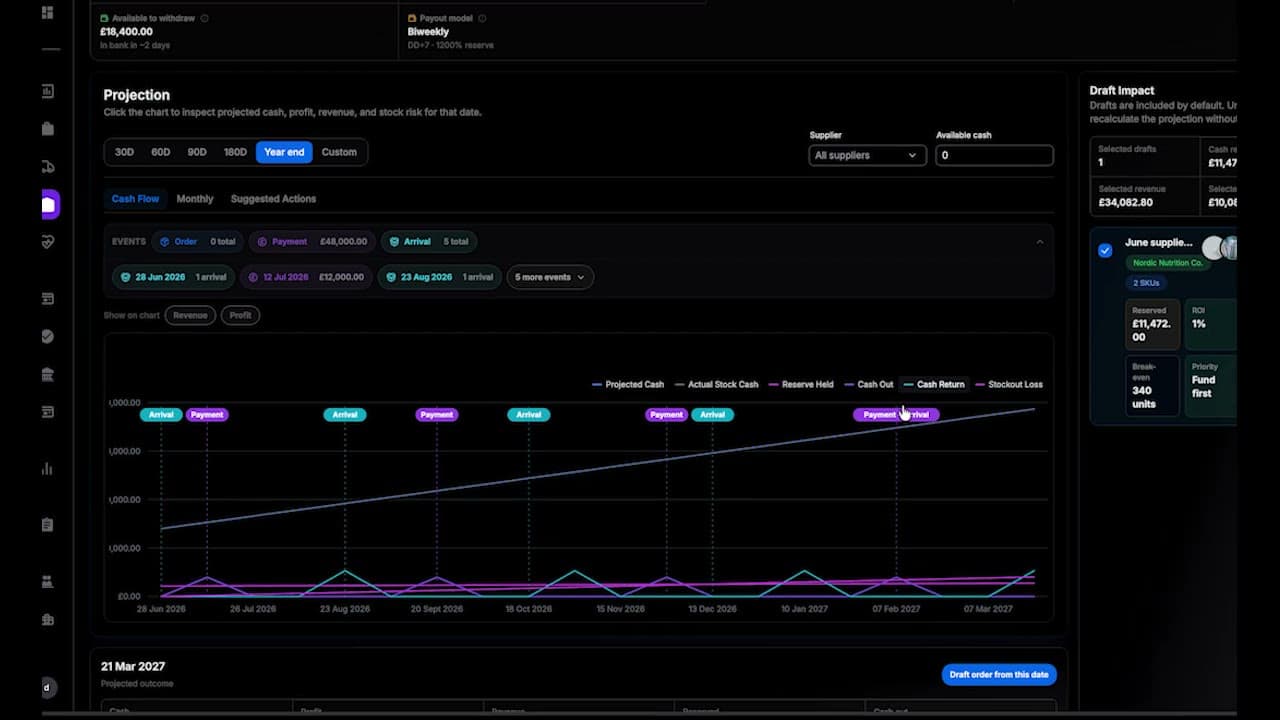
Forecasting, stock cover, cash impact and profit in one clear view.
Buy Plan Studio
Buy Plan Studio forecasts lead times from your real shipment averages, with a manual override when you know better, then turns velocity into draft replenishment orders. Every draft shows the full projection — month-by-month cash flow, revenue, profit, ROI and the date your cash comes back — so you decide whether to buy, wait or move the money to a better SKU.
See which SKUs are moving, how fast they are selling and where stock cover is tightening.
Turn replenishment recommendations into draft restock orders before cash leaves the business.
Model what an order does to profit, stockout risk, storage exposure and available cash.
Know whether to restock, hold cash, clear slow stock or recover money from Amazon.
Buy plan projection
Lead time
28 days
avg · editable
Cash low
£4.8k
Oct 14
Revenue
+£18.6k
projected
ROI
62%
on this buy
Pulse · 16 engines, always on
Pulse runs 16 engines across revenue, fees, payouts, cash and stock to score your business health in real time. It checks whether you are on track for your projections, and when inventory is the reason you are not, it queues the highest-impact next move — before it becomes a stockout or dead cash.
Velocity changed enough that the next order date should move forward.
Projected cash dips below the safer threshold if the full order is placed today.
Inventory cover is high enough that buying more would create dead cash.
Quick answers
These are the inventory signals that change whether a seller should buy more stock, wait, recover cash or move capital into a better SKU.
Amazon FBA inventory management is the process of tracking sellable, reserved, stranded, inbound and missing stock so sellers know when to restock, recover cash or stop buying.
Manage FBA inventory by checking sales velocity, days of stock cover, supplier lead times, storage fees, inbound shipments, reserved units and SKU-level profit before placing a replenishment order or updating quantities in Seller Central.
Amazon FBA reserved inventory is stock inside Amazon's network that is not immediately available to sell because it may be tied to customer orders, transfers or fulfilment processing.
Amazon FBA stranded inventory is stock stored by Amazon that cannot currently be purchased, often because of listing, catalogue, pricing or account issues.
FBA storage limits, utilisation, aged inventory and long-term surcharges affect how much stock sellers can hold and how much margin inventory keeps after storage cost.
Lost or missing FBA inventory reduces cash and profit unless the seller finds the discrepancy and files a reimbursement or fee-error claim.
Buying criteria
Good Amazon FBA inventory software should show what can sell, what is tied up, what is costing money and which SKUs deserve the next purchase order. GoWrath is built around these criteria for profit-led FBA operators.
See the full GoWrath platform to watch Pulse, suppliers and draft orders work together, or review the Amazon FBA profit tracker page for the P&L view behind inventory decisions.
Separate the stock that can sell from inventory that is reserved, stranded, inbound or missing.
Use sales velocity and stock cover to know when a SKU needs attention.
Turn a restock signal into a draft order before committing cash.
See whether the order improves profit, protects stock cover or ties up too much cash.
Watch aged stock, utilisation and long-term surcharges before they eat margin.
Find lost-inventory and fee-error claims instead of leaving recoverable cash with Amazon.
FBA risk areas
The high-value FBA inventory subtopics are not separate from profit. In 2026, capacity limits, inventory health signals, IPI history, reserved stock, stranded units and missing inventory all change how much cash is available and how much margin a SKU really keeps.
Capacity limits, utilisation, aged inventory and long-term surcharges can turn stock into trapped cash. GoWrath's Advanced Storage Fees help you see those costs before they eat margin.
Reserved inventory can make total FBA units look healthier than the stock you can actually sell. Treat it as an availability signal, not a simple unit count.
Stranded inventory is cash sitting in FBA while the SKU cannot sell. It needs fixing, discounting or removing based on margin and storage exposure.
Lost and missing FBA inventory can become recovered cash. GoWrath's Advanced Reimbursements automatically find and file lost-inventory and fee-error claims.
Problem, risk, fix
Every FBA inventory problem carries a cash or margin cost. Here is how GoWrath turns each one into a clear next move.
| Inventory problem | Business risk | How GoWrath helps |
|---|---|---|
| Reserved inventory | You reorder on inflated unit counts, or run out of what is actually sellable. | Separates sellable stock from reserved, inbound and stranded so restocks use true availability. |
| Stranded inventory | Cash sits in FBA earning nothing while storage fees keep charging. | Flags stranded SKUs against margin and storage cost so you fix, discount or remove them fast. |
| Lost & missing inventory | Money Amazon owes you for lost or damaged units goes unclaimed. | Advanced Reimbursements automatically find and file lost-inventory and fee-error claims. |
| Storage limits & aged stock | Long-term surcharges erode margin and capacity caps block restocks. | Advanced Storage Fees surface utilisation, aged stock and surcharge exposure before they bite. |
| Overstock & slow stock | Dead cash and rising storage fees on inventory that will not turn. | Pulse flags high stock cover and draft orders model the cash impact before you buy. |
| Stockouts | Lost ranking, velocity and sales when a SKU runs dry. | Pulse watches velocity and restock timing so draft replenishment orders go out on time. |
| Supplier & COGS blind spots | Reorder timing and true margin become guesswork. | Supplier and Profit dashboards tie lead times and COGS to net SKU profit and payout timing. |
Send inventory to Amazon FBA
Sending inventory to Amazon FBA works best when every SKU has already passed the business checks: sellable stock, reserved units, sales velocity, supplier lead time, storage exposure and cash impact.
Use GoWrath to decide what should go into Seller Central's Send to Amazon workflow, then keep the shipment connected to inbound inventory, receiving, reserved status, missing units, reimbursement opportunities and the profit each restock is expected to return.
Profit-led operations
GoWrath connects inventory decisions to the money behind them: suppliers, replenishment, storage fees, reimbursements, net SKU profit and payout analysis. That makes each restock easier to compare against every other use of cash in the business.
Use it to see which SKUs deserve stock, which orders should wait, where storage cost is building and where Amazon may owe money back.
£19.99
per month
10 suppliers
£37.99
per month
50 suppliers
£69.99
per month
Unlimited suppliers
See it in motion
You already know the pieces — lead-time forecasting, draft buy plans, full cash and revenue projections, and the always-on Pulse health score. Here is the full GoWrath demo — watch it end to end, or skip to the parts you care about.
FAQ
These answers target the practical questions sellers ask when they need an Amazon inventory tracker that also protects margin.
Start a 14-day free trial and connect up to 3 months of backdated data to see inventory, storage fees, reimbursements and profit in context.